Every batch,
written down the
same morning.

A sheet goes on the clipboard for each batch before the drum is charged and comes off it when the beans are cool. These are the last eight, copied out exactly — including the one that went two degrees long and never went on sale.

Sheets here
418 back to 411
Kept since
Sheet 001, March 2019
Written by
Whoever had the tongs
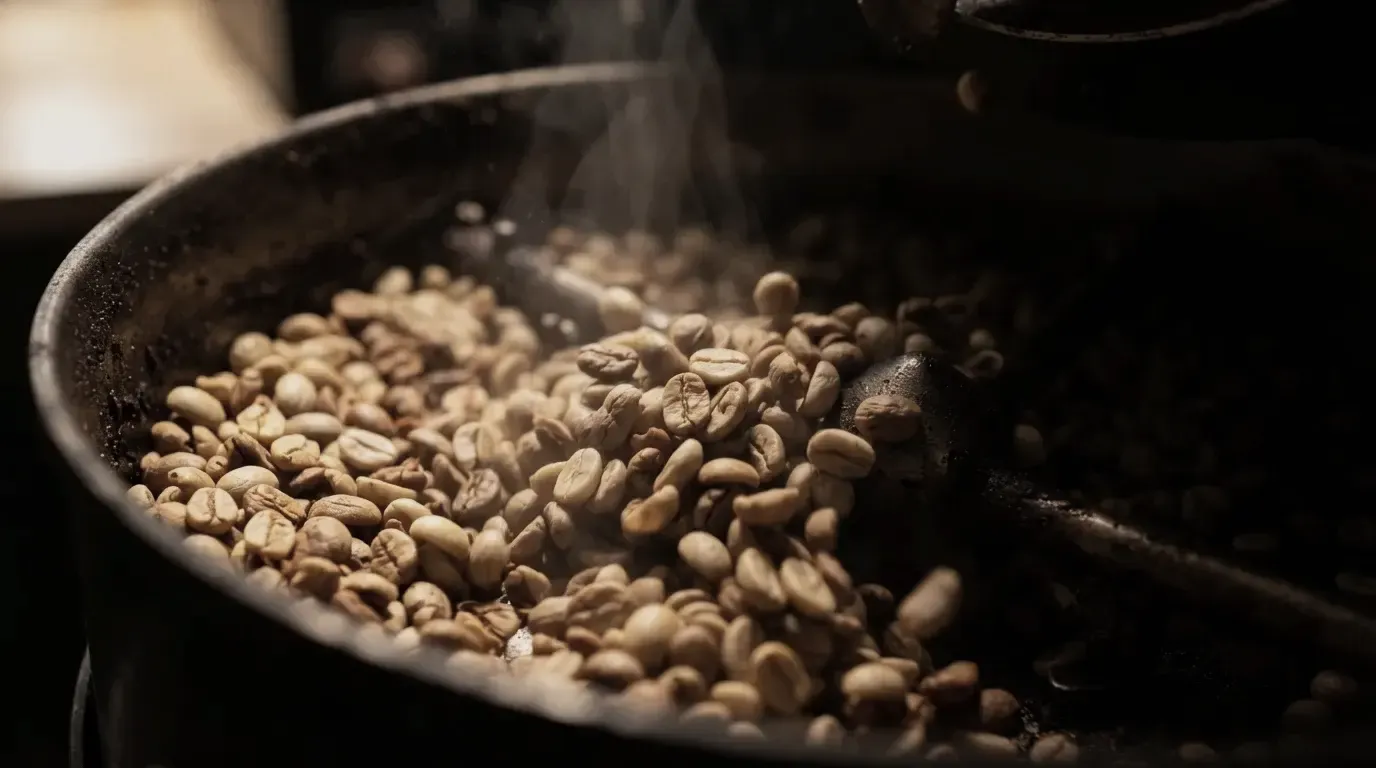
Macro photograph of coffee beans turning straw yellow inside a roasting drum

160 °C

4:30

The part of a roast you can only read by eye, which is exactly why the rest of it gets written down. Straw, then tan, then a trier every thirty seconds.

The last eight batches

Sheets 411–418 · 30 July to 13 August · 12 kg drum

  1. Sheet418 Day Lot Gitwe Green12.0 kg Turn1:42 Crack8:36 Drop10:22 · 204 °C Devel.1:46 · 17.0 % Loss15.4 %

    First full batch of the new Rwandan. Held the gas down through the turning point because naturals scorch at the drum wall, and it still arrived at the crack eight seconds early. Sheet stands as the reference.

  2. Sheet417 Day Lot Cerro Azul Green12.0 kg Turn1:48 Crack8:54 Drop11:02 · 208 °C Devel.2:08 · 19.3 % Loss16.0 %

    Third batch of the morning, so the drum was already hot and the turning point came six seconds sooner than on batch one. Air up a notch from the crack to keep the finish clean.

  3. Sheet416 Day Lot Karimikui Green11.6 kg Turn1:38 Crack8:20 Drop10:05 · 203 °C Devel.1:45 · 17.4 % Loss14.6 %

    Short charge — the sack was down to its last 11.6 kg. A lighter load climbs faster, so the gas came off ten seconds earlier than the sheet says and the curve landed on top of the reference anyway.

  4. Sheet415 Day Lot La Ilusión Green12.0 kg Turn1:45 Crack8:48 Drop10:40 · 206 °C Devel.1:52 · 17.5 % Loss15.1 %

    Reference roast. Nothing to report, which is the point of writing it down.

  5. Sheet414 Day Lot Sítio Bela Vista Green12.0 kg Turn1:52 Crack9:06 Drop11:28 · 211 °C Devel.2:22 · 20.6 % Loss16.8 %

    The long one. Two minutes twenty-two of development and the trier still came out matte — no oil at the surface, which is where we want to stop. Second crack would have been about forty seconds further on.

  6. Sheet413 Day Lot Alaka Green11.0 kg Turn1:34 Crack8:12 Drop9:44 · 202 °C Devel.1:32 · 15.8 % Loss14.1 %

    Charged eleven kilos rather than twelve. This is the densest green in the room and a full drum stalls it through the drying phase; the smaller load holds momentum and drops a clean forty seconds sooner.

  7. Sheet412 Day Lot Cerro Azul Green12.0 kg Turn1:51 Crack9:04 Drop11:14 · 208 °C Devel.2:10 · 19.3 % Loss15.8 %

    Cold morning, cold drum, and the whole curve ran ten seconds late from the turning point onward. Development ratio held, so the coffee cupped level with sheet 417 — the clock moved, the shape did not.

  8. Sheet411 Day Lot Karimikui Green12.0 kg Turn1:39 Crack8:26 Drop10:18 · 205 °C Devel.1:52 · 18.1 % Loss15.0 %

    Two degrees long. Missed the crack by a few seconds over a delivery at the door and the blackcurrant came back as plum on the table. Sold as staff coffee, not as Karimikui. It is on the sheet because it happened.

Reading the sheet

Probe on bean mass · logged every second · written by hand

Development, not the clock

The number we steer by is the one on the right of the sheet: the time from first crack to the drop, as a share of the whole roast. A cold morning stretches every figure on the row and changes nothing about how the coffee tastes, as long as that ratio holds. Sheets 412 and 417 are the same coffee ten seconds apart and cupped level, which is the clearest argument for the ratio we have.

The turning point

Twelve kilos of green at room temperature drop the drum by seventy degrees in ninety seconds. The turning point is where that stops and the bean begins to heat instead. It moves with the load, the weather and how many batches have gone before it — which is why the third roast of a morning is never given the same gas as the first.

Weight loss

Water and chaff, weighed out of the batch. Fourteen per cent is a light washed lot, seventeen is as far as we go. It is the cheapest check on the sheet: if the loss is right and the ratio is right, the roast is almost certainly right, and if the loss drifts a point the probe is usually the thing that is lying.

Why sheet 411 is on the list

Because it happened. That batch went two degrees long, tasted of plum instead of blackcurrant, and was drunk in the roastery rather than sold. A log with the bad mornings taken out of it is an advertisement, not a record, and it would be no use to us the next time somebody knocks on the door at the wrong minute.
Longer notes — cupping tables, why we changed a curve, what a new harvest did to a lot we thought we knew — go in the journal. The sheet only ever carries numbers and one line of what happened.

Ask us about
any row on it.

If a sheet raises a question — why that curve, why that drop, why we stopped where we did — send it over. We would rather answer it than have you guess, and it is a short walk to the clipboard.

Cut-off is Tuesday 20:00 for the Thursday roast. Or call the roastery on 01632 960 118, weekdays 08:00–16:00.